
A few months ago, I wrote a paper about my personal relationship with creativity and conformity in my lifelong hobby of roller coaster design. Completing the paper reinvigorated my passion for coaster design, which had been waning for some time.
In the summer of 2022, I joined the official Discord server for No Limits 2, my coaster design tool of choice for nearly a decade. The NL2 community regularly holds design contests. So for the first time in my life, I actually entered one of these competitions. And then a second one.
In light of my recent exploration of creativity in coaster design, I thought it valuable to share my process of competing in these contests, and of course, the results.
Biker Blowout
First was the Prison Break Coaster Contest. The challenge was to design a coaster within the provided environment of an island prison.
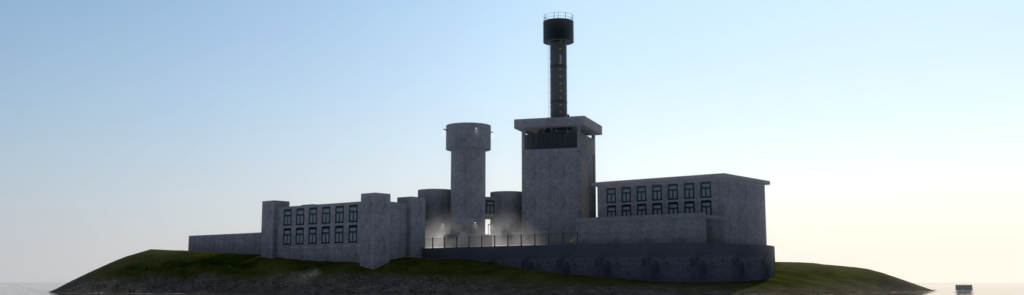
The emphasis in this contest was realism (at least, aside from the fact that the coaster is built upon a prison). Specifically, each entry was expected to conform to the style of an existing coaster manufacturer. The layout, elements, forces, infrastructure, and supports ought to believably resemble something a real manufacturer might construct. It’s worth noting that coaster enthusiasts are generally well-acquainted with the styles of different design firms; it’s akin to a tech enthusiast being familiar with the hardware and software practices of Apple, Microsoft, Google, etc.
This contest’s prison theme inspired me to base my coaster on Vekoma’s motorbike model, in which riders straddle their seats like a motorcycle. I researched videos and images of the motorbike coasters that Vekoma have built around the world, studying their layouts and support structures to find tropes to include and expand upon in my design.
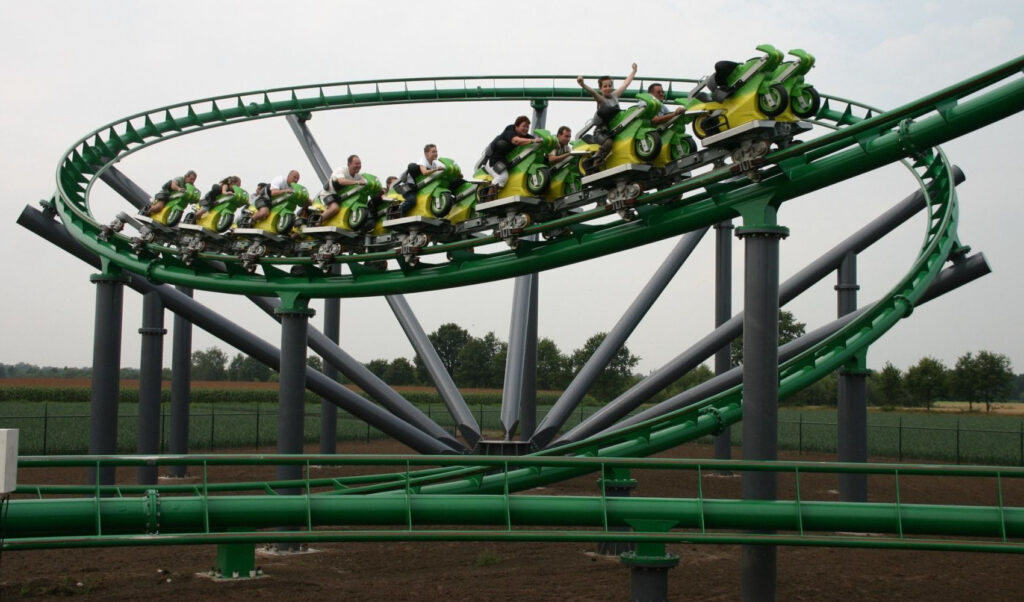
Vekoma have made significant strides in the last few years with some of their newer (non-motorbike) models. I decided it would be an interesting exercise to modernize the Vekoma motorbike with some of these recent innovations, as the real-world motorbike installations are all over a decade old.
Another creative strategy I employed, which I use on most of my coasters, is environmental interaction. I designed my layout to hug natural contours of the island, sneak under bridges, and follow along roofs and walls of the prison. These choices aren’t strictly necessary, but I always prefer coasters like this, as they seem to belong in their environment, rather than being superimposed atop it.
Below is the video I produced to showcase my contest entry! Credit goes to my exceedingly talented sister for creating the Biker Blowout logo.
In the end, there were 21 submissions to the contest, and the results were published in a video presenting the various entries. My entry received the award for the best family thrill ride, as in a coaster that can be fun for both adults and (brave) kids. I also tied for first place in the judging category of creativity. In their notes, the judges complimented how my layout interacted with the scenery (as I’d hoped!), and for the unique inclusion of a tilt track on a motorbike coaster – something that has yet to be done in real life, but is theoretically possible.
I earned sixth place overall in the competition, an outcome I am perfectly pleased with. Many members of the NL2 community have a much stronger grasp than I on the minutiae of realistic coaster design. Indeed, the two judging criteria in which I lost the most points were in the shaping of elements and the realism of support structures.
Scallywag
The second competition I entered was the Tropica Island Hopper Contest. The focus of this challenge was layout and support work. The majority of the provided environment was open water, upon which we were prohibited from building any supports. Note that No Limits 2 ‘s physics engine does not analyze the integrity of support structures whatsoever; the viability of the supports would purely be enforced by the judges’ critiques.
The contest was presented with a pirate theme. Naturally, I knew I ought to construct a rickety old wooden coaster, rather than steel. However, this would make adhering to the rules about supports much more difficult, because the dense supports of a wooden coaster run directly underneath the entirety of the track. In contrast, steel coasters’ sparse support beams can accommodate unusual topography with relative ease. This only reinforced my motivation to go wooden – I was eager to push the limits of my skillset and make something I’d never seen before.
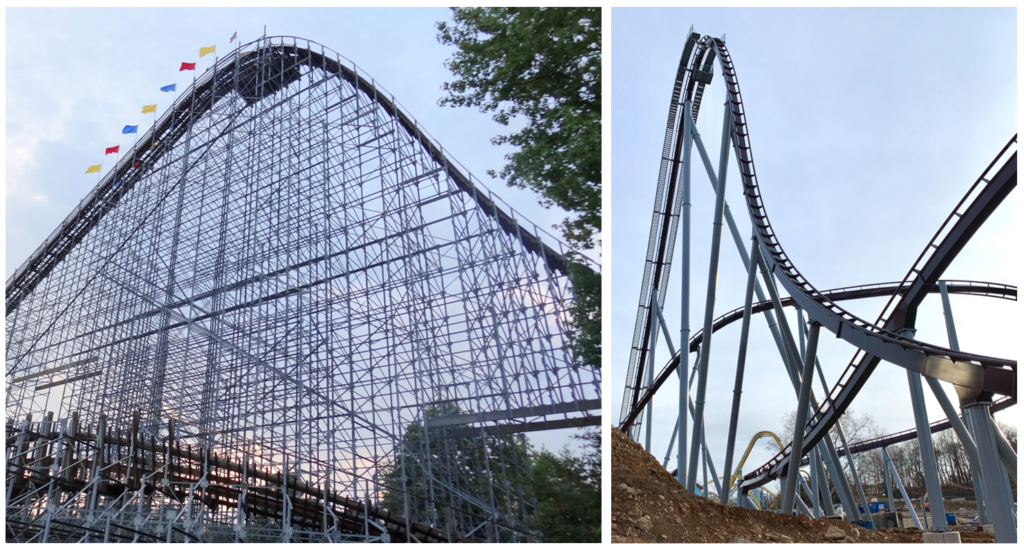
From the beginning of the design process, I kept in mind my unique self-imposed constraints. There would be two issues to confront with the support structure. First: how to support the track sections situated over the water? I realized this problem was solved thousands of years ago: arches! In multiple sections of the layout, I would build wooden arches to believably bridge gaps between permitted support footer locations.
The second problem concerned height. When a wooden coaster is particularly tall, the support structure must flare out to either side to improve stability, like a skyscraper which gets wider towards its base. I knew this would not be possible where the track passed over water, so I had two choices for each water section: keep the track low enough that a narrow support lattice seemed reasonable, or (cosmetically) reinforce taller structures with cables in tension. These limited options meant the coaster would have to be relatively small and gentle.
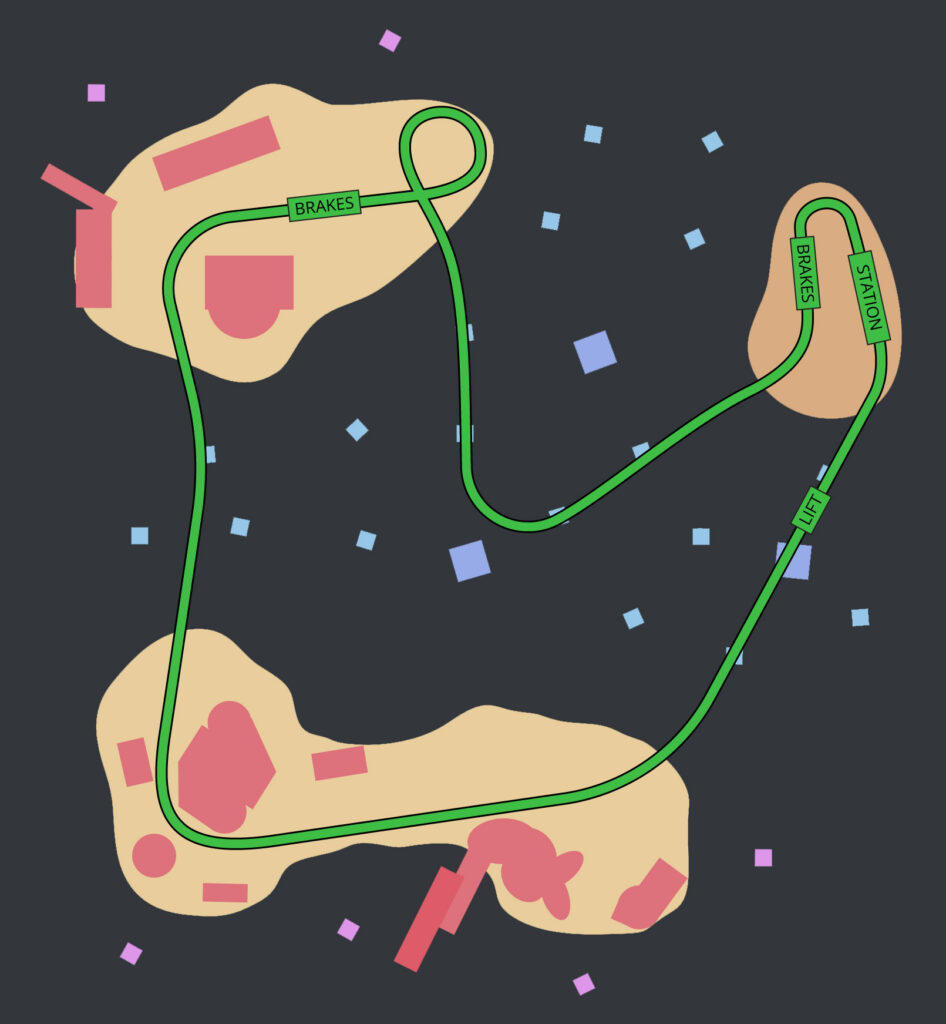
Usually I will design a coaster’s layout spontaneously as I construct each element. But with all of these unique constraints, I chose to plan the whole layout for this coaster before beginning construction. Below is a top-down view of the environment, with an approximation of the final layout. The rules required that we traverse all three islands at least once, and prohibited entering the red zones which contained trees, buildings, and other scenery. The squares scattered about the water are rafts upon which we could place a limited number of supports.
Below is the result – one of my favorite coasters I’ve ever designed. Once again, my sister created the Scallywag logo.
Out of the 12 contest entries, mine was the only wooden coaster. As I’d hoped, the community was highly complementary of my unique support work, recognizing how much effort must have gone into the arch structures. The judges awarded me an honorable mention for my supports as well.
I earned 4th place overall in the contest, which is again an excellent outcome. As expected, other submissions featured more precise and nuanced element shaping – details invisible to anyone outside the hobby, but immediately evident to me. Additionally, because of the difficulty and time investment of the support construction, I tempered my ambitions regarding track layout. My competitors submitted coasters with more complex and impressive layouts, deserving of better scores.
Closing Thoughts
I poured my soul into a paper in which I worried that my creativity in coaster design was suffering, that I was bound helplessly to the trappings of realistic design. And then, in two competitions with a focus on realism, I pushed the boundaries of my skills and was commended for my creativity.
Perhaps my worry has been unwarranted.
Especially to an outsider like me, your work on these two designs is astounding, and your presentation of them in these videos, is astounding. Bravo Jared!